Building Businesses for the Long Term: Meet Mitchell Francis, Group Leader of Castor Group
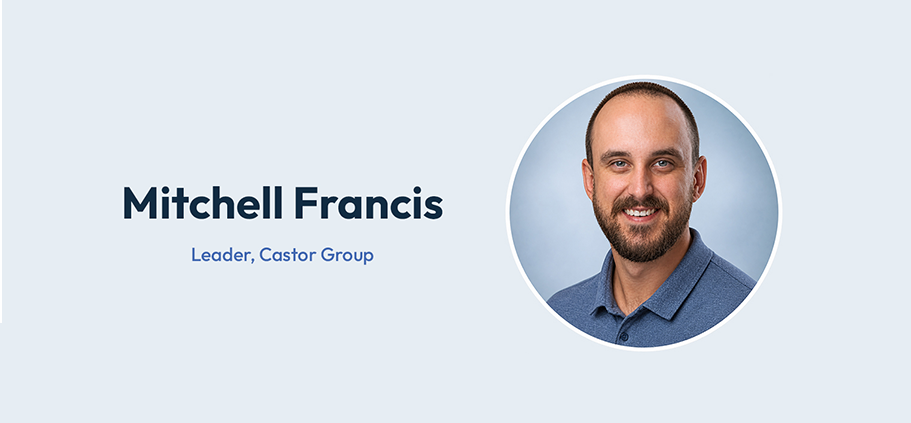
Mitchell Francis has spent nearly nine years with Constellation Software, in roles spanning M&A, operations, general management, and portfolio leadership.
Earlier this year, he joined Castor Group as Group Leader, working with Wintech, CalcAir, and NexJ. We spoke with Mitchell about how he got here, what he’s learned from Castor’s businesses and customers so far, and why AI is taking up a fair bit of his attention.
You’ve held a number of roles across Constellation. What path brought you to Castor?
I joined CSI in 2018 in mergers and acquisitions, primarily focused on deal sourcing. I was young, bright-eyed and bushy-tailed, and still had hair at the time.
I wanted to make my mark, so I spent a lot of time trying to broaden my understanding of M&A. I took courses after work, stayed late at the office, worked through modelling and diligence exercises, and I’d ask people on the execution team if I could redo work they had already completed, just to make sure I understood it properly.
That led me from sourcing into M&A execution and diligence, and then into helping build a more decentralized business development function across Perseus.
But I’d always had an entrepreneurial interest as well. I ran a landscaping company in high school, hiring my buddies and running crews, and ran a painting business during university. While I understood M&A, I wanted to know more about what it actually meant to operate a business.
I eventually moved into an operational role within Constellation Financial Software and then became a General Manager. That was my first real deep dive into operations, and it gave me a very different appreciation for the work. It’s easy to sit in the M&A world and manage a business through a spreadsheet. It’s a whole lot different being boots on the ground, working with employees and customers and dealing with all the challenges that come with that.
From there, I moved into broader portfolio management with Maverick Group while continuing to work on acquisitions and capital deployment.
Then, earlier this year, I joined Gemini and Castor. It gave me the opportunity to get back to what I like to do best: operations, along with a growing focus on AI and how we can get better at using it across the company.
Castor Group’s businesses serve very different markets. How do you approach leading them?
Constellation is a culture of cultures. We have shared values, but every business has its own culture. NexJ’s culture is very different from CalcAir’s, which is very different from Wintech’s. It’s important to respect what makes each business successful while continuing to operate around those shared values.
For me, empowering people is the most important part. You want to push decision-making power as close to the market as possible because those leaders know their markets and customers better than anybody.
I can step in where it makes sense, whether that’s helping with a strategic initiative, finding the right resources elsewhere in Constellation, or acting as a thought partner.
But the leaders of those businesses should have the room to run them and make the decisions they believe are right.
What has stood out for you about Castor’s customers and markets so far?
One thing I’ve found particularly interesting is the level of trust customers have in these products. At Wintech, for example, some customers specifically include experience with our software in their job descriptions when they’re hiring. That’s not something I was used to seeing, and it shows how well respected the tool is in the market.
The actuarial side adds another dimension. Customers rely on our calculations to be correct, but they’re the ones signing the actuarial reports. In many ways, they’re putting their own professional reputation in our hands.
There’s a deep level of trust there. We have to make sure we continue earning it by providing accurate, reliable calculations and products.
Where do you see opportunities for Castor companies to learn from one another?
The obvious answer is AI.
We’re all on the AI literacy journey together. How do we learn from what other teams are doing? How do we understand what’s working, get inspired by one another, and avoid everyone having to figure out the same things independently?
We’ve started regular AI spotlights across the group, including sessions for R&D as well as more general sessions. The whole idea is to drive those shared learnings.
There’s also the broader Constellation network. Sometimes the most useful thing I can do is connect a team with people, tools, or resources they may not otherwise know are available to them.
As technology continues to change, what should established software businesses stay focused on?
Getting close to your customer will always be what makes us successful. In many ways, code is cheap these days. What matters is whether you’re solving the right problems for customers.
We already have longstanding relationships and trust with our customers. We need to keep investing in those relationships and make sure our products continue to meet their changing needs.
But we should also be asking: what else can we help them solve?
We know these markets well. We know our customers. And we can now move more quickly when there’s an opportunity to build something that helps them.
Looking ahead, what excites you most about Castor?
A lot of our businesses have real growth potential. I’m excited to keep finding interesting ways to expand those opportunities, whether that’s through new products, new customers, new geographies, or potentially new acquisitions.
What interests me is continuing to solve interesting challenges for a devoted customer base, while also creating opportunities for our employees to grow.
Away from work, what keeps you busy?
I’m a really big cyclist, particularly long-distance road cycling.
I’ve done rides like the Princess Margaret Toronto-to-Niagara ride, which is about 260 kilometres over two days, as well as the Northern Pass in Muskoka. You find a good group, and you can draft sometimes, but sometimes you’re also just battling to stay alive and trying to keep up. That endurance side of cycling is a big part of why I enjoy it.
These days I’m also building a bike to take my son to school and back every day, so cycling can look a little different depending on the day. And outside of that, I’m a full-time dad. That keeps me pretty busy.
Connect with Mitchell on LinkedIn.
Contact Us
If you’re considering an exit for your own company, it’s never too early to start a conversation. You can reach us here.